
You leave the massage table feeling looser than you’ve felt in weeks. Then a few days later — sometimes just a few hours — the same spot in your neck or shoulder tightens right back up.
If that sounds familiar, the massage wasn’t wasted, and you’re not doing anything wrong. It’s just addressing part of what’s going on. Here’s the part that usually gets left out, and a different way to approach the spots that never seem to stay loose.
Key Takeaways: Why That Spot Keeps Tightening Up
- It’s rarely “just” a muscle. What feels like a knot is often a muscle-and-nerve feedback loop — tight muscle fiber paired with irritated nerve endings that keep feeding each other.
- Massage works on half the loop. Pressure and movement boost blood flow and loosen the muscle, but they don’t directly calm the nerve irritation underneath, which is often why the tightness returns.
- Start here. For a full look at how we approach chronic tightness and pain, see our Pain Relief page.
- Red light therapy works on the other half. Skin-contact, phase-based light sequencing targets inflammation and nerve activity directly, without any pressure involved.
- You don’t have to choose. Plenty of our clients still get regular massages and add red light therapy specifically for the one or two spots that never stay loose.
What a “Knot” Really Is
What most people call a knot is usually what’s known as a myofascial trigger point — a small, tender area of tight muscle fiber. Research into trigger points suggests the pain and tenderness there isn’t purely mechanical. Ongoing irritation in the area appears to involve the nerves themselves: inflammatory signaling can build up around the site, sensitizing nearby nerve endings and making that spot more reactive to touch and movement.
In plain terms: a knot usually isn’t a muscle problem sitting in isolation. It’s a feedback loop — the muscle stays tight, the surrounding nerves become more sensitive, and that sensitivity helps keep the muscle tight.
Why Massage Helps — But Doesn’t Always Last
Massage is genuinely effective at what it does. Manual pressure and movement increase blood flow to the area, work through some of the tension in the tight muscle band, and can interrupt the cycle enough to bring real, if temporary, relief. That’s not nothing — plenty of people get real value from that.
The gap: because massage works on the muscle primarily from the outside, it doesn’t necessarily do much to calm the nerve irritation and inflammatory signaling sitting underneath. If that part of the loop is still active, the muscle has every reason to tighten back up once the effects of the massage wear off. That’s the “it felt amazing, then it came right back” pattern so many people describe.
How Red Light Therapy Approaches It Differently
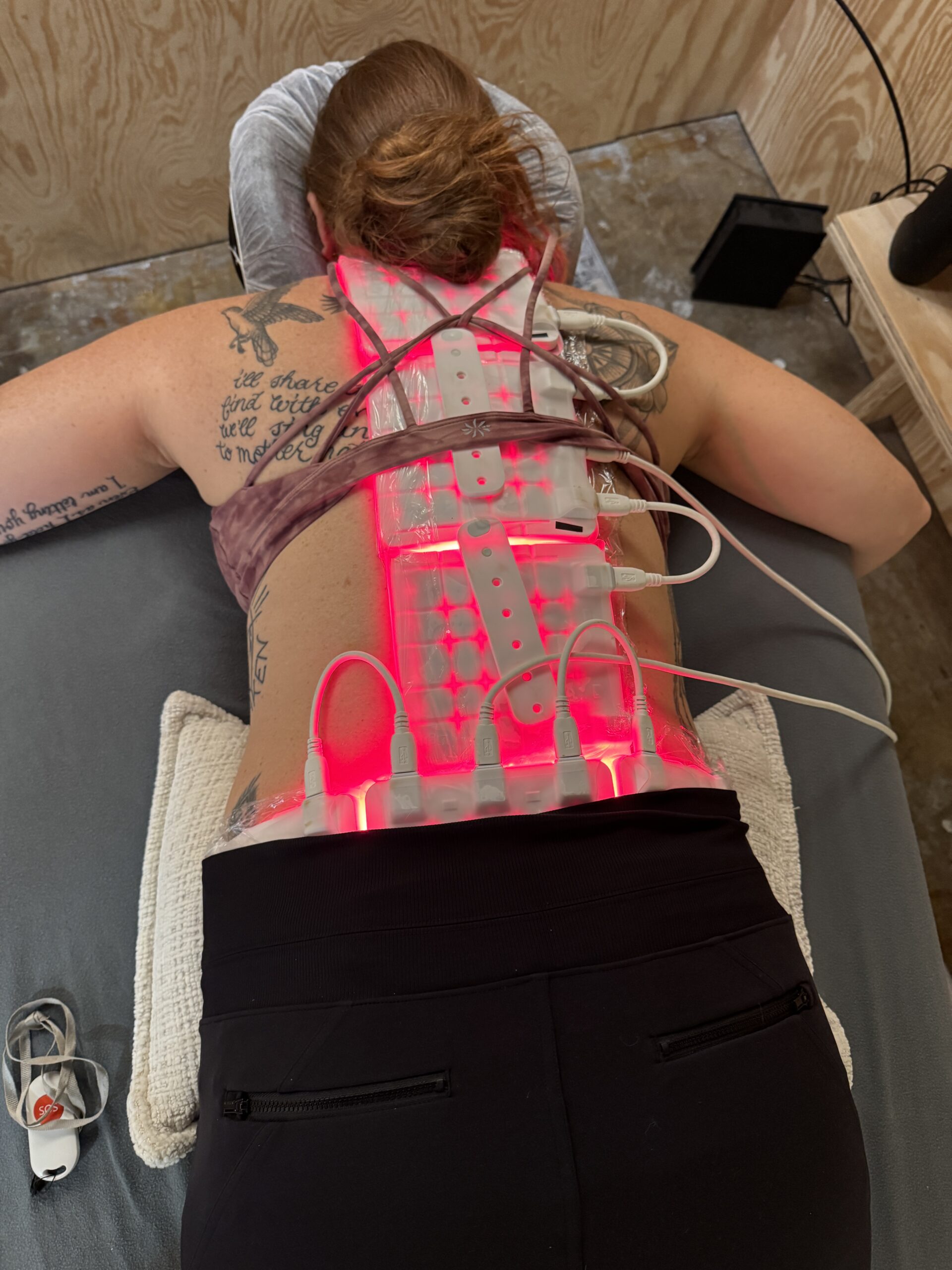
At Austin Red Light Therapy, sessions use medical-grade, skin-contact light pads rather than manual pressure. There’s no manipulation involved. You lie still while pulsed light is delivered directly into the tissue at the treatment site — which also makes it a good option when an area is too sensitive for hands-on work.
Phase-Based Light Sequencing
Each session moves through several phases rather than applying one flat setting: first supporting circulation and oxygenation to the area, then supporting tissue repair, then working to calm inflammation at the cellular level. That last phase is the piece manual therapy has a harder time reaching, because it’s addressing the inflammatory and nerve-level activity that keeps recruiting the muscle into staying tight, not just the muscle itself.
What the Research Shows
This isn’t just theory. Photobiomodulation’s effects on nerve function have been studied directly: a systematic review of photobiomodulation therapy for diabetic peripheral neuropathy found consistent improvement in both neuropathic pain and nerve conduction velocity across the studies it examined. Separate mechanistic research has linked red and near-infrared light to reduced inflammatory signaling and calmer nerve activity at the cellular level — the same biological territory a stubborn “knot” lives in.
For more on how we tailor sessions to specific injuries and recovery timelines, see our Recovery from Injury or Surgery page.
Massage or Red Light Therapy? You Don’t Have to Pick One
Honestly, it doesn’t have to be either/or. Some of our clients still get regular massages and add red light therapy specifically for the areas that keep tightening back up, using each for what it’s good at. Others come to us because pressure on the area isn’t comfortable in the first place — common when a nerve is genuinely irritated — and they want something effective that doesn’t rely on it.
This combination tends to work well for:
- Recurring neck or shoulder tightness that comes back to the exact same spot
- “Tech neck” and desk-related tension
- Post-workout soreness that settles in the same area every time
- Areas where deep pressure feels uncomfortable rather than relieving
If you keep going back to a massage therapist for the exact same spot, that’s often a sign the underlying inflammation or nerve irritation hasn’t been addressed. It might be worth trying a different approach for that specific spot.
Frequently Asked Questions
Is Austin Red Light Therapy a massage clinic?
No. We don’t offer hands-on bodywork or manual massage. We use medical-grade, skin-contact light therapy, which many clients find just as relaxing but works through a completely different mechanism — light instead of pressure.
Can red light therapy help with recovery the way a massage does?
For a lot of the goals people bring to a massage — easing tightness, reducing soreness, supporting recovery — yes, though the approach is different. See our Recovery from Injury or Surgery page for how we tailor sessions to recovery specifically.
Why does my massage knot come back within a few days?
Most likely because the tightness has a nerve and inflammation component that manual pressure doesn’t fully resolve. The muscle relaxes temporarily, but the underlying irritation is still there, so it re-tightens.
Is red light therapy or massage better for nerve-related pain?
If pressure on an area is uncomfortable or makes symptoms worse, that’s often a sign a nerve is involved, and red light therapy may be the more comfortable option since it doesn’t require any manipulation of the area.
How many sessions before I notice a difference?
This varies by person and by how long the tightness has been going on. Most people feel a difference after 1-3 sessions. See our What to Expect page for a realistic look at session frequency and cumulative results.
Try a Different Approach for That Recurring Spot
We offer 20, 40, and 60-minute sessions at Atomic Athlete in East Austin, plus mobile service (40- and 60-minute only) if that’s more convenient.
Sources
- “Myofascial Trigger Points Then and Now: A Historical and Scientific Perspective,” PM&R — https://pubmed.ncbi.nlm.nih.gov/25724849/
- Korada HY, et al., “Effectiveness of Photobiomodulation Therapy on Neuropathic Pain, Nerve Conduction and Plantar Pressure Distribution in Diabetic Peripheral Neuropathy: A Systematic Review” — https://pubmed.ncbi.nlm.nih.gov/37622461/
- “Photobiomodulation Therapy in Neuropathic Pain: Mechanisms, Evidence, and Future Directions,” Frontiers in Photonics (2025) — https://www.frontiersin.org/journals/photonics/articles/10.3389/fphot.2025.1730347/epub
